DORA (Gesetz über digitale operationale Resilienz)
Entdecken Sie, wie Brainframe Ihnen helfen kann, Ihre DORA-Compliance-Bemühungen effektiv umzusetzen und zu verwalten
DORA-Compliance leicht gemacht
Das Gesetz über digitale operationale Resilienz (DORA) setzt einen neuen Standard für Finanzinstitute und gewährleistet robuste Sicherheit und operationale Resilienz angesichts digitaler Bedrohungen. Brainframe wurde entwickelt, um Ihren Weg zur DORA-Compliance zu vereinfachen, indem es ein umfassendes Informationssicherheitsmanagementsystem (ISMS) bereitstellt, das mit den Anforderungen von DORA übereinstimmt. Bleiben Sie den Vorschriften mit optimiertem Risikomanagement, Echtzeitüberwachung, Dokumentenmanagement – alles auf einer Plattform – voraus. Stellen Sie die Resilienz und Compliance Ihrer Organisation mühelos sicher.
Wer ist betroffen?
Investment- und Versicherungseinheiten
Umfasst Investmentfirmen und
sowohl Versicherungs- als auch Rückversicherungsunternehmen,
die sich auf Vermögensverwaltung,
Finanzprodukte und Risikodeckung konzentrieren.
Markt- und Infrastrukturanbieter
Diese Gruppe umfasst zentrale Gegenparteien (CCPs),
zentrale Wertpapierverwahrstellen (CSDs),
Handelsplätze, Handelsregister,
und Datenberichterstattungsdienstleister
die die Infrastruktur des Finanzmarktes unterstützen.
Banken und Zahlungsinstitute
Diese Kategorie umfasst Banken, Zahlungsdienstleister
und elektronische Geldinstitute, die
finanzielle Transaktionen und Kunden
konten verwalten

Risikomanagement
Die Anforderungen von DORA an das Risikomanagement verlangen von den Finanzinstituten, umfassende Rahmenbedingungen zu schaffen, um digitale Risiken in allen Betriebsabläufen zu identifizieren, zu bewerten und zu mindern. Diese Rahmenbedingungen müssen ein breites Spektrum an Risiken abdecken, einschließlich Cyberbedrohungen, Abhängigkeiten von Dritten und operationale Verwundbarkeiten, mit direkter Beteiligung des Managements.
Vorfallmanagement
Die Anforderungen von DORA an das Vorfallmanagement stellen sicher, dass Finanzinstitute über robuste Prozesse verfügen, um ICT-bezogene Vorfälle schnell und effektiv zu erkennen, darauf zu reagieren und sich davon zu erholen. Diese Prozesse müssen klare Kommunikationsprotokolle, Verfahren zur Eskalation von Vorfällen und regelmäßige Tests zur Aufrechterhaltung der operationale Resilienz umfassen.
Resilienztests
Die Anforderungen von DORA an Resilienztests verlangen von den Finanzinstituten, ihre ICT-Systeme und -Prozesse regelmäßig zu testen, um sicherzustellen, dass sie Störungen standhalten und sich davon erholen können. Diese Tests müssen eine Reihe von Szenarien abdecken, einschließlich Cyberangriffe und operationale Ausfälle, und sollten sowohl interne Systeme als auch Drittanbieter einbeziehen.
TPRM
Die Anforderungen von DORA an das Risikomanagement von Dritten betonen die Notwendigkeit für Finanzinstitute, die Risiken, die von ihren ICT-Dienstleistern ausgehen, zu bewerten und zu managen. Die Institute müssen robuste Due-Diligence-Prozesse implementieren, die Leistung von Dritten (und vierten und fünften) kontinuierlich überwachen und sicherstellen, dass Verträge Bestimmungen für Sicherheit und Resilienz enthalten.
DORA Best Practices
Verstehen Sie den Umfang und die Anforderungen
Das Verständnis des Umfangs und der Anforderungen von DORA ist der entscheidende erste Schritt zur Erreichung der Compliance. Dies beinhaltet die Identifizierung, wie DORA auf Ihre Organisation zutrifft, einschließlich der spezifischen Finanzdienstleistungen oder ICT-Dienstleistungen, die der Regulierung unterliegen.
Erste Risikobewertung
Dies beinhaltet die Identifizierung und Bewertung potenzieller ICT-bezogener Risiken in Ihrer Organisation, einschließlich Cyber-Bedrohungen, operationale Verwundbarkeiten und Abhängigkeiten von Dritten. Durch die frühzeitige Bewertung dieser Risiken können Sie Maßnahmen zur Minderung priorisieren, geeignete Kontrollen zuweisen und eine Grundlage für den Aufbau eines widerstandsfähigen Risikomanagementrahmens im Einklang mit den Anforderungen von DORA schaffen.
Risikomanagementrahmen
Dieser Rahmen sollte Strategien, Richtlinien und Verfahren zur Identifizierung, Bewertung und Minderung von ICT-Risiken umreißen. Er muss klar definierte Rollen und Verantwortlichkeiten, Kontrollen, die spezifischen Risiken zugewiesen sind, und Prozesse für kontinuierliches Monitoring und Überprüfung enthalten, um sicherzustellen, dass Ihre Organisation Risiken proaktiv managen und die operationale Resilienz in Übereinstimmung mit DORA aufrechterhalten kann.
Richtlinien und Verfahren
Richten Sie Richtlinien ein, die Informationssicherheit, Netzwerkmanagement, Zugangskontrolle, Vorfallreaktion und Resilienzstrategien abdecken und sicherstellen, dass sie mit den regulatorischen Standards übereinstimmen. Klare Verfahren müssen für die Umsetzung dieser Richtlinien festgelegt werden, mit definierten Rollen, Verantwortlichkeiten und Genehmigungsprozessen. Dieser strukturierte Ansatz gewährleistet Konsistenz, Verantwortlichkeit und Compliance in Ihrer gesamten Organisation.
Kontrollen und Maßnahmen umsetzen
Dies beinhaltet die Implementierung der notwendigen technischen und organisatorischen Kontrollen zur Bewältigung identifizierter Risiken, wie z.B. Cybersicherheitsmaßnahmen, Zugangsmanagement und Vorfallreaktionsprotokolle. Jede Kontrolle sollte mit dem Risikomanagementrahmen abgestimmt sein, um sicherzustellen, dass potenzielle Schwachstellen proaktiv gemindert werden. Eine effektive Umsetzung dieser Kontrollen schützt Ihre IKT-Ressourcen und verbessert die operationale Resilienz.
Einen Vorfallreaktionsprozess einrichten
Dieser Prozess sollte klare Verfahren zur Erkennung, Meldung und Verwaltung von IKT-bezogenen Vorfällen definieren, einschließlich Rollen und Verantwortlichkeiten für die Reaktionsteams. Er muss Richtlinien für Kommunikation, Eskalation und Wiederherstellung enthalten, um eine schnelle und koordinierte Reaktion während Störungen zu gewährleisten. Ein gut definierter Vorfallreaktionsprozess hilft, die Auswirkungen zu minimieren und unterstützt die organisatorische Resilienz.
Dokumentieren und aufzeichnen
Die Dokumentation aller Aspekte Ihrer DORA-Compliance-Bemühungen ist entscheidend für Transparenz und Verantwortlichkeit. Dazu gehört die detaillierte Aufzeichnung von Vermögenswerten, Prozessen, Richtlinien, Verfahren, Risikobewertungen, Kontrollen, Tests und Vorfällen. Eine ordnungsgemäße Dokumentation stellt sicher, dass alle Maßnahmen und Entscheidungen nachvollziehbar sind, erleichtert Audits und Überprüfungen und bietet einen klaren Bezug für die fortlaufende Compliance und kontinuierliche Verbesserungsbemühungen.
Kontinuierliche Verbesserung
Überprüfen und aktualisieren Sie regelmäßig Ihren Risikomanagementrahmen, Ihre Richtlinien und Kontrollen basierend auf Leistungskennzahlen, Audit-Ergebnissen und aufkommenden Bedrohungen. Durch die Einbeziehung von Feedback, die Überwachung der Wirksamkeit und die Anpassung an Veränderungen im regulatorischen Umfeld stellen Sie sicher, dass Ihre Risikomanagementpraktiken im Laufe der Zeit robust und effektiv bleiben.
Überblick über Brainframe
Vermögensverwaltung
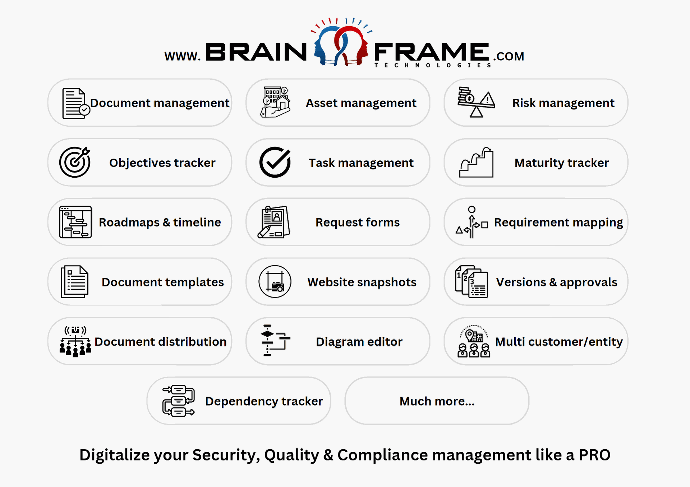
Brainframe ermöglicht es Ihnen, ein umfassendes Inventar Ihrer Vermögenswerte zu führen und diese nahtlos den Prozessen zuzuordnen, die sie unterstützen. Es erlaubt Ihnen, jedem Vermögenswert ein Kritikalitätsniveau zuzuweisen, sodass Sie die wichtigsten Ressourcen Ihrer Organisation effektiv priorisieren und verwalten können.
Risikomanagement
Brainframe ermöglicht es Ihnen, Ihre Risiken für jeden Vermögenswert oder Prozess zu definieren, deren Kritikalitätsniveau zu bestimmen, Maßnahmen zur Minderung zu planen und zu priorisieren und bietet eine umfassende Übersicht, um alle Ihre Risiken in einem zentralen Dashboard zu verfolgen.
Richtlinienmanagement
Nutzen Sie die umfassenden Vorlagen von Brainframe, um die von DORA geforderten Richtlinien und Verfahren effizient zu entwickeln. Weisen Sie spezifische Rollen und Verantwortlichkeiten dem Management zu, um deren aktive Beteiligung und Verantwortung im Prozess der Richtlinienerstellung und Entscheidungsfindung sicherzustellen.
Reifegradmanagement
Ordnen Sie Ihre Kontrollen ihren Anforderungen zu und verfolgen Sie den Reifegrad Ihrer Compliance-Rahmenwerke. Dank der tiefen Integration mit dem Aufgabenmanager können Sie Ihren Fortschritt anzeigen und die Effizienz Ihrer Audits verbessern.
Erreichen Sie DORA-Compliance mit Brainframe
Selbstgehostete Lösung
Brainframe kann nahtlos auf Ihrer lokalen Infrastruktur implementiert werden, wodurch Sie die volle Kontrolle über Ihre Daten und Systeme haben. Diese Bereitstellungsoption gewährleistet die Einhaltung interner Sicherheitsrichtlinien und regulatorischer Anforderungen und bietet gleichzeitig die gleichen leistungsstarken Funktionen und Möglichkeiten wie die cloudbasierten Lösungen von Brainframe. Mit der lokalen Implementierung können Sie die Plattform an Ihre einzigartige Umgebung anpassen und so optimale Leistung und Integration mit der bestehenden Infrastruktur sicherstellen.
Cloud-Lösung
Brainframe is available as a cloud-based solution, offering flexibility and scalability without the need for complex infrastructure management. This deployment option ensures quick implementation and automatic updates, while maintaining the highest levels of security and compliance. With Brainframe in the cloud, you can access the platform from anywhere, enabling seamless collaboration and ensuring that your organization stays resilient and up-to-date with minimal overhead.
Discover our solution for each of these DORA requirements for a better overview on how Brainframe can help you :
DORA requirement | Brainframe Solution |
Article 5 : Governance and organisation This section outlines the responsibilities of the management body of financial entities with regards to managing ICT risk, including the creation of policies, definition of roles and responsibilities, and establishment of governance arrangements. |
|
Article 6 : Risk Management framework Article 6 defines the structure of the required frameworks to be implemented for DORA. They must include strategies, policies, procedures, ICT protocols and tools that mitigate risks and protect ICT assets. It requires controls to be assigned to risks, and the framework must be documented and regularly reviewed. It must include a resilience strategy. |
|
Article 8 : Identification Financial entities must identify, classify and properly document ICT business functions, information assets, roles and dependencies in order to mitigate ICT risk, and maintain an inventory of all their assets and processes. |
|
Article 9 : Protection & Prevention DORA sets out measures related to the development and documentation of policies on information security, network infrastructure management, access control, and authentication mechanisms, along with policies on patching and updating. These policies must be approved by management. |
|
Article 10 : Detection DORA requires to put in place mechanisms to promptly detect anomalous activities, regular testing, devoting sufficient resources and capabilities to monitoring user activity and the occurrence of ICT anomalies. |
|
Article 11 : Response & Recovery To ensure the continuity of their operations, financial entities must put in place a comprehensive ICT business continuity policy, associated ICT response and recovery plans, and ICT business continuity plans. They must conduct yearly BIAs and keep records of activities during disruptions. |
|
Article 12 : Backup policies and procedures, restoration and recovery procedures and methods Article 12 aims to ensure that ICT systems and data can be restored with minimal disruption and loss in the event of an incident by requiring financial entities to develop and document backup and restoration policies and procedures, which are to be tested regularly. |
|
Article 13 : Learning & Evolving Financial entities must have in place ICT security awareness training programmes for staff, and they must update their risk management framework regularly to stay up to date with emerging cyber threats. |
|
Article 14 : Communication Financial entities must have in place crisis communication plans for the disclosure of major ICT-related incidents to the clients, and, when appropriate, to the public. |
|
DORA requirement | Brainframe Solution |
Article 17 : ICT-related incident management process DORA requires you to establish a process for ICT-related incident management, including establishing early warning indicators, procedures for identifying, tracking, logging and classifying ICT-related incidents, assigning roles and responsibilities for incidents, plans for communication and notification, and ICT-related incident response procedures. Major ICT-related incidents must be reported to management. |
|
Article 18 : Classification of ICT-related incidents and cyber threats Article 18 requires financial institutions to classify ICT-related incidents based on criteria such as the number of affected clients, the geographical spread, the amount or number of transactions affected, the duration of the incident and the data losses that the incident entails. |
|
Article 19 : Reporting of major ICT-related incidents and voluntary notification of significant cyber threats Financial entities must report major ICT-related incidents to the relevant competent authority within a certain time frame, which can be as little as four hours after the detection of the incident. |
|
DORA requirement | Brainframe Solution |
Article 24 : General requirements for the performance of digital operational resilience testing Financial entities must establish and maintain a sound and comprehensive risk-based digital operational resilience testing programme, including a range of assessments, tests, methodologies and tools. |
|
Article 25 : Testing of ICT tools and systems DORA requires you to perform tests adapted to relevant asset including vulnerability assessments and scans, open source analysis, network security assessments, gap analyses, physical security reviews, questionnaires, scanning solutions, source code reviews, scenario tests, compatibility tests, performance tests, end-to-end tests, and penetration testing. |
|
Article 26 : Advanced testing of ICT tools, systems and processes based on TLPT Article 26 requires that critical or important functions of the financial entity must be tested using threat-lead penetration testing, and must involve ICT third-party service providers contracted by the financial entity. |
|
DORA requirement | Brainframe Solution |
Article 28 : General principles Financial entities must manage third-party ICT risk as an integral component of their ICT risk management framework. Financial entities must adopt and regularly review a strategy on ICT third-party risk and update a register of information related to all contractual arrangements with ICT third-party service providers. |
|
Article 30 : Key contractual provision The contractual arrangements on the use of ICT services must include information such as the description of functions, locations for data processing, provisions for data security, service levels, availability of data and assistance with ICT incidents as well as termination rights and conditions. |
|
DORA requirement | Brainframe Solution |
Article 45 : Information-sharing arrangements on cyber threat information and intelligence This is an optional section encouraging financial institutions to exchange amongst themselves cyber threat information and intelligence, with the goal of enhancing digital resilience in the financial sector. |
|
Audit trail
Brainframe ensures a comprehensive and automated audit trail by recording all actions, changes, and updates made within the system. It tracks user activities, policy modifications, risk assessments, and compliance measures, providing clear, time-stamped documentation. This detailed audit trail not only simplifies internal and external audits but also ensures transparency, accountability, and alignment with regulatory requirements like DORA
KPIs
Brainframe enables comprehensive KPI monitoring, providing a centralized dashboard for tracking key performance metrics across departments or product lines. It offers real-time insights to ensure clear visibility into progress and performance. This streamlined approach facilitates data-driven decision-making and helps maintain alignment with organizational goals and compliance requirements
Integrations
Brainframe supports seamless integrations with your existing systems (SharePoint, JIRA, Monday.com,...) allowing you to easily import documents and records. This ensures a smooth transition by centralizing all relevant files within the platform, reducing manual work, and maintaining consistency. By integrating your current document workflows, the software helps streamline processes and enhance efficiency across your organization.
Interested in knowing more?
Book a call to find out more on how we can help you achieve and manage your compliance with DORA
Start for free now!
Streamline your GRC work using our all-in-one management solution and get access to our network of local specialists